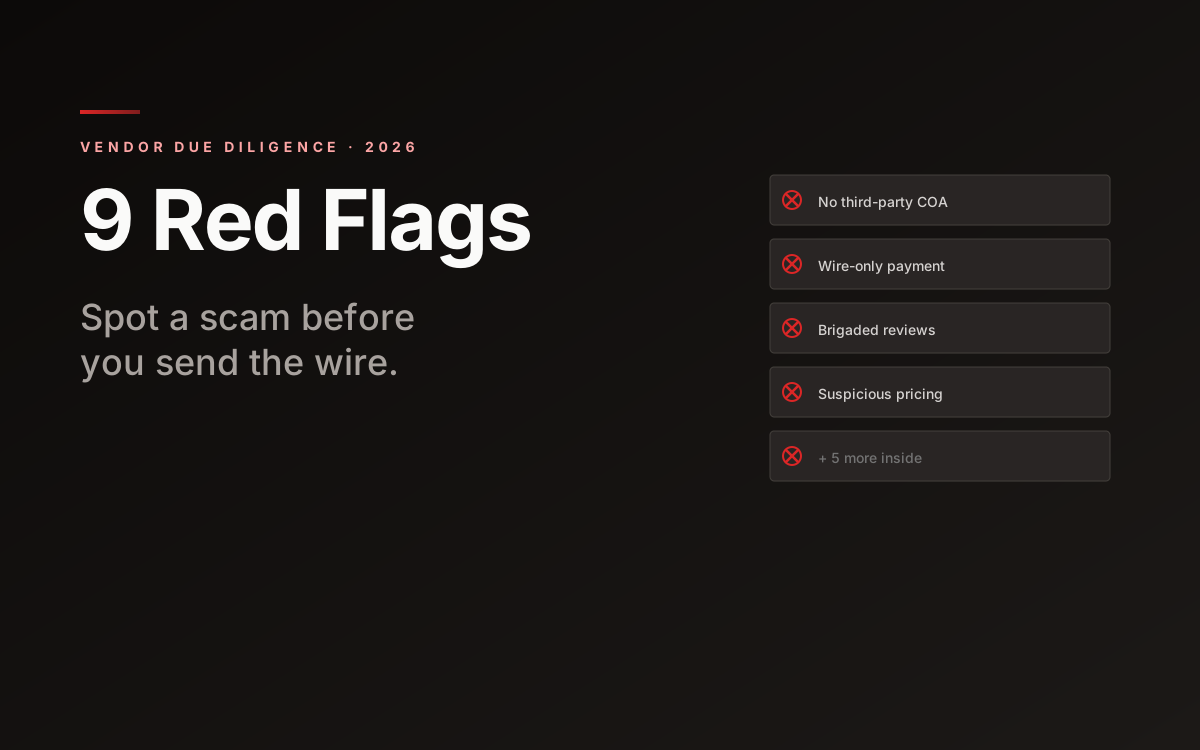
Compare the vendors behind the claims
Use live pricing, lab results, and community reviews to evaluate peptide vendors before you click out.
There are more counterfeit peptides on the market than legitimate ones in 2026. Most look identical to the real thing on a product page. The differences only show up when you ask for documentation that the vendor cannot produce, or when an independent lab tests what you actually received.
This is a practical checklist, not a list of "trusted" brands. Brand recommendations age badly because the vendors that were good two years ago routinely sell out, change ownership, switch manufacturers, or get replaced by a copycat with a similar URL. The patterns below age well — they are how the field actually works.
If you are evaluating a specific vendor, our vendor directory tracks third-party COA history, complaint patterns, and ownership changes across the active US-facing market.
Red flag 1 — No third-party certificate of analysis (COA), or a COA that cannot be verified
A certificate of analysis from an independent lab is the single most important document a peptide vendor can provide. A real COA names the testing laboratory, lists the analytical methods (HPLC, mass spectrometry, peptide content assay), reports the lot number, and is signed by a named analyst. You should be able to email the testing lab, quote the COA's report number, and have them confirm it is real.
The scam pattern, in order of how common it is in 2026:
- No COA at all. Disqualifying.
- An "in-house" COA produced by the vendor's own lab. Better than nothing, but not third-party. Treat this as a marketing document, not evidence.
- A third-party COA whose report number, when emailed to the testing lab, returns "no record." This is the most common active scam in the GLP-1 segment. The vendor photoshops a real lab's letterhead onto fabricated data.
- A COA for one lot, used to cover every product on the site. Real labs report on a specific lot of material. If the same COA appears on twelve different product pages, the vendor is recycling it.
Verify by emailing the testing lab directly. If the lab will not confirm, the COA is forged.
Red flag 2 — Unverifiable identity for the testing lab
A real peptide testing lab has a website, a physical address, ISO 17025 accreditation (or equivalent), and a phone number that someone answers. The accreditation matters: ISO 17025 is the international standard for testing laboratory competence and is what regulators look for.
Look up the lab independently. If the vendor's COA cites "Janoshik Analytical" or "Pharm Lab USA" or any other commonly-cited testing facility, search the lab's name plus "ISO 17025" and verify the accreditation number on the accrediting body's database. Some labs the vendors cite are real and accredited. Some exist only as a logo on a forged PDF.
Red flag 3 — Payment methods that prevent chargeback
Legitimate research-peptide vendors in 2026 accept some combination of credit card, ACH, or stable-coin payment. Many also accept Bitcoin because the regulatory category they operate in (research-use-only chemicals) makes traditional payment processing difficult.
The red flag is when the only accepted payment methods are wire transfer, Zelle, Venmo "friends and family", or gift cards. These are payment rails specifically chosen because they prevent chargebacks. A vendor that refuses every reversible payment method is telling you they expect customer disputes.
A second-order tell: vendors that accept credit card but charge a 5–8% "processing fee" to use it. The fee is real but the math does not add up — they are nudging you toward irreversible payment.
Red flag 4 — The "shipping insurance" upsell
Watch the checkout flow. A common scam pattern: the vendor accepts a normal payment method, charges a reasonable price, and then adds a mandatory "shipping insurance" or "customs handling" fee at the final step. The fee is paid to the vendor, not to a real insurer. When the package never arrives — because it was never sent — the vendor blames "customs seizure" and points to the "insurance" line item, which they then refuse to honor.
Real shipping issues happen. Real shipping insurance is a line item paid to a real insurer (USPS, UPS, etc.) and the receipt names the carrier. If "shipping insurance" appears as a line item and the carrier is not named, treat it as a deposit on a problem the vendor is about to invent.
Red flag 5 — Prices that are dramatically below market
Peptide manufacturing has hard floors. The synthesis cost of a 5 mg vial of a moderately complex peptide (BPC-157, GHK-Cu, ipamorelin) lands somewhere between $4 and $9 in raw cost from a competent contract manufacturer. Add purification, lyophilization, vialing, third-party testing, packaging, and shipping, and the floor for a real product is typically $20–35 retail.
The math gets steeper for the GLP-1 class. Real, third-party-tested research-grade retatrutide cannot retail for $40 a vial. The synthesis is too expensive. Vendors selling at that price are either selling something else under the retatrutide name, or skipping the testing step entirely.
A useful heuristic: if a vendor is more than 40% under the median of the rest of the market for the same compound, the price differential is almost always covering counterfeit content, not "operational efficiency."
Red flag 6 — Brigaded reviews with consistent grammatical fingerprints
Look at the review pattern. Real review pages on a research-vendor look like this: a long tail of moderate reviews, a handful of complaints (often shipping-related), occasional outliers, varied writing quality, and review dates spread across months and years.
Brigaded reviews look different. Twenty 5-star reviews posted within a 48-hour window. Identical sentence structure. Similar typo patterns. Reviewer names that are first-name-plus-letter ("Mike T", "Steve P") with no review history elsewhere on the platform. Reviews that read product-feature lists rather than experience descriptions.
Trustpilot, Google Reviews, and Reddit threads each get manipulated differently. Cross-check across all three. If a vendor has glowing Trustpilot reviews, no Reddit footprint at all, and zero independent forum discussion, the reviews are paid.
The honest test: search the vendor's name plus "scam" on Reddit. Real vendors have a mix of positive threads and the occasional shipping complaint that gets resolved in comments. Scam vendors have either nothing (brand-new operation) or a wave of identical takedown posts following them across subreddits.
Red flag 7 — Branding that mimics established vendors
The active scam pattern in 2026: registering a domain that is one character off from a known vendor (e.g. vendor-research.com versus vendorresearch.com), copying the design language, and intercepting customers who type the URL slightly wrong or click an SEO-poisoned ad.
Verify the URL character-by-character. If you got to the vendor through a paid Google ad, check that the domain on the ad matches the domain you typed in independently. Counterfeit storefronts buy ads on competitors' brand names specifically because Google's enforcement on this category is inconsistent.
A second pattern: legitimate-sounding business names with no underlying corporate registration. A real research-supply business in the US has a registered LLC or corporation, an EIN, and a physical address. The address should be a commercial address, not a UPS Store mailbox. Run the business name through your state's Secretary of State business search. Vendors operating without state registration are operating outside any legal recourse you have.
Red flag 8 — No published manufacturing or quality-control standards
A serious peptide vendor publishes some version of their standards: which contract manufacturer (CMO) they use, what synthesis purity they target (typically ≥98% by HPLC), what the QC release criteria are, how lots are stored before shipment, and what the shelf-life claim is based on.
The scam pattern is silence on every one of these. The vendor's "About" page is one paragraph of generic mission-statement copy. There is no mention of the manufacturer. There is no purity claim. There is no shelf-life statement. There is no documentation of how the product is stored before shipment.
Compare to a real vendor: a specific synthesis spec, a named CMO (or at least a country of manufacture and a specific purity standard), HPLC-MS method for QC release, cold-chain shipment with ice packs and tracked transit time. You should be able to read the vendor's quality page and understand what they actually do, not just what they claim to do.
Red flag 9 — Customer service that disappears after the order
The final test happens after you have already paid. Email the vendor a specific question: ask for the COA on the lot you received, with the lot number cross-checked against the testing lab.
Three response patterns:
- Real vendor. Replies within 24–48 hours with the requested COA, the lot number, and the testing lab's contact info. Sometimes apologetic about delays. Always specific.
- Mediocre vendor. Replies within a week with a generic "all our products are tested" response and no documentation. Will eventually produce something if you push, often a single COA used across all lots.
- Scam vendor. Replies once with placeholder language, then ghosts. The customer-service email starts auto-responding "we're experiencing high volume" within 7–10 days of the order. Refund requests go unanswered. The vendor's Trustpilot suddenly fills with new 5-star reviews drowning out the complaints.
The asymmetry is the giveaway. Sales emails answered in 90 minutes; post-order support takes weeks or never arrives.
How to use this checklist
Run a candidate vendor through nine items. A score of 9/9 (no flags present) is what a real vendor looks like in 2026. 7–8/9 is the median legitimate vendor with operational issues but no fraud. 5–6/9 is risky. Below 5/9 is a vendor you should not send money to.
Two specific scenarios where the bar is higher than the average:
GLP-1 class compounds (semaglutide, tirzepatide, retatrutide). The dollar volume in this segment is large enough that counterfeiting is structurally profitable. Counterfeit risk is the highest in the entire market. Sourcing reality is covered in detail in our GLP-1 comparison guide, specifically for retatrutide, where no approved supply exists yet.
BPC-157 and other recovery peptides. Highest counterfeit prevalence outside the GLP-1 class. The community discussion volume is large enough that scam vendors invest heavily in SEO and review brigading. Cross-reference vendor claims against the broader research record summarized in our evidence-based peptide tier list.
How Boren scores vendors
Our vendor directory tracks every vendor we have evaluated against this checklist plus six additional dimensions: COA history across lots (not just the most recent), shipping reliability over the prior 90 days, complaint resolution rate, ownership transparency, response time on post-order support, and price stability versus the market median. Vendors are scored on each dimension and the underlying data is public.
If you want to see how we score a specific vendor, the directory page links to the underlying COAs we have collected and the complaint thread history we have catalogued. Live discussion of vendor experiences happens in our research forum, where the most active threads track shipping reliability week-over-week across the major active vendors.
The summary: most online peptide vendors will not pass this checklist. That is not a flaw in the checklist.
Frequently asked questions
- How do I know if a peptide vendor is legit?
A legitimate peptide vendor publishes third-party certificates of analysis (COAs) from an ISO 17025-accredited testing lab, accepts reversible payment methods (credit card, ACH), names its contract manufacturer or country of synthesis, has a registered LLC with a verifiable physical address, and answers post-order support emails within 48 hours. A vendor that fails any one of those checks is a yellow flag; failing three or more is disqualifying.
- What is a certificate of analysis (COA) for peptides?
A COA is a document from an independent testing laboratory reporting the identity, purity, and content of a specific lot of peptide material. Real COAs name the testing lab, list the analytical methods used (typically HPLC and mass spectrometry), include the specific lot number, and are signed by a named analyst. The COA's report number should be verifiable directly with the testing lab — emailing the lab and quoting the number should return confirmation.
- Why are some peptides priced so much lower than others?
Peptide synthesis has hard cost floors. A 5 mg vial of moderately complex peptide costs $4–9 in raw synthesis from a competent manufacturer; once purification, lyophilization, vialing, third-party testing, packaging, and shipping are added, the floor for a real product is typically $20–35 retail. Vendors selling more than 40% under market median are almost always covering counterfeit content, not operational efficiency.
- Are counterfeit GLP-1 medications a real problem?
Yes. The FDA has issued direct consumer warnings and pursued enforcement actions against counterfeit semaglutide since 2024. The dollar volume in the GLP-1 segment is large enough that counterfeiting is structurally profitable, and the research-peptide market for retatrutide — which has no FDA-approved supply — has the highest counterfeit risk of any peptide today.
- Can I trust online reviews when picking a peptide vendor?
Cross-check across at least three sources before trusting them. Real review patterns include moderate scores, varied writing quality, dates spread across months, and the occasional shipping complaint resolved in comments. Brigaded review patterns include 20+ five-star reviews posted within 48 hours, identical sentence structures, and reviewer names that have no review history elsewhere. A vendor with glowing Trustpilot reviews but zero independent Reddit footprint is paid.
Sources
Save vendors and track price drops
Create a free account to save your shortlist and get alerts when new prices or lab tests are added.